
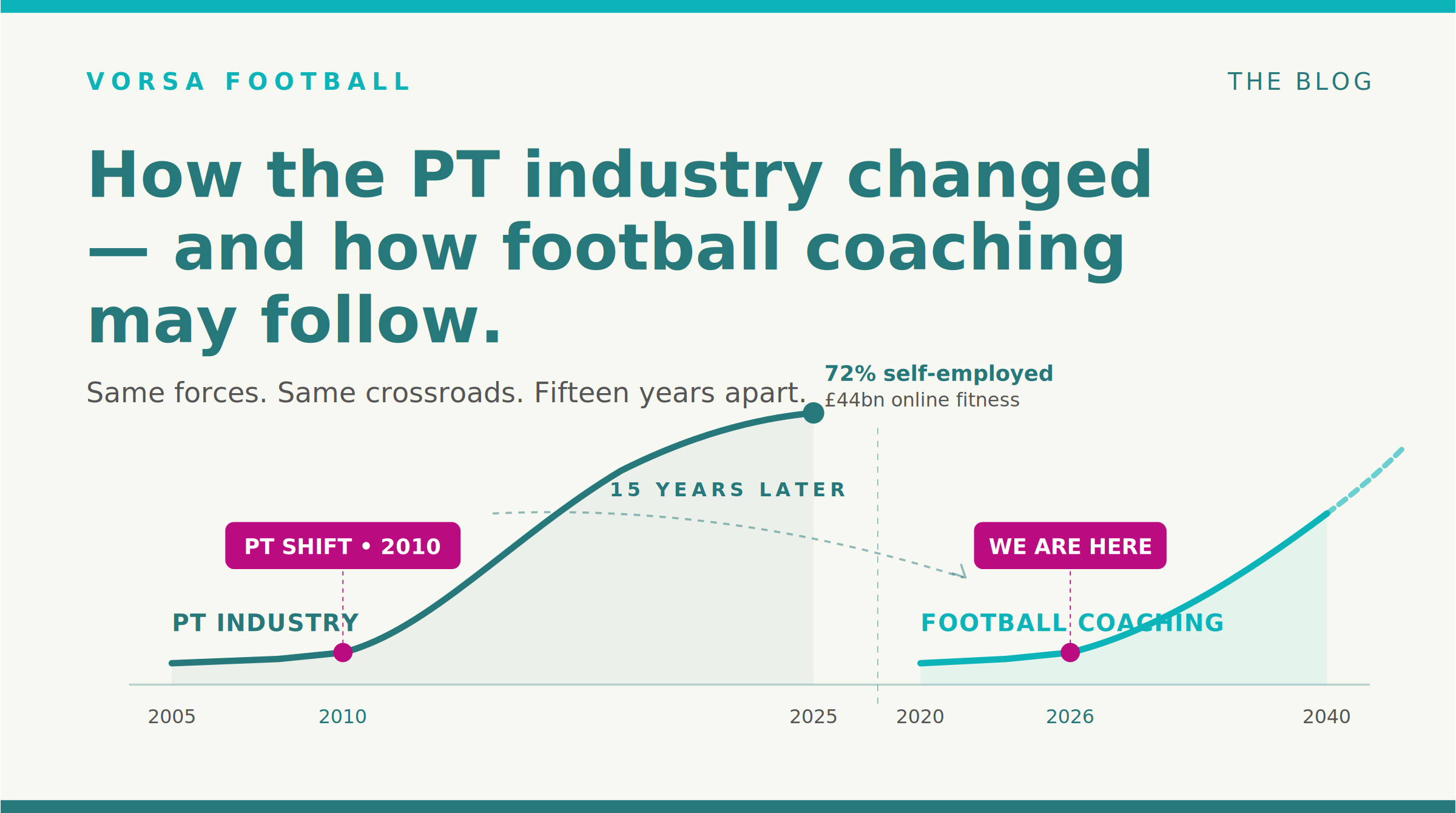
How the PT Industry Changed — and How Football Coaching Should Follow
Twenty years ago, almost every personal trainer was the face of someone else's gym. Today, the most successful ones are the face of themselves. Football coaching is sitting at the same crossroads.
By James | Vorsa Football | 9 min read
If you'd walked into any commercial gym in Britain in the early 2000s, you would have seen the same setup. A row of personal trainers in branded polo shirts, working for the gym, training the gym's members, on the gym's hours, at the gym's rates. They were good at their jobs. They were also almost completely interchangeable to the people paying for them.
Today, the same gyms are still there. The polo shirts are still there. But the best PTs aren't wearing them anymore.
The industry quietly went through one of the biggest shifts you'll see in any service business in a generation. The personal trainer stopped being an employee of a brand. They became the brand.
I think football coaching is now sitting exactly where the PT industry sat fifteen years ago. And I think the same shift is about to happen — slower, but it's coming.
The personal trainer didn't get replaced by an app. They built one.
Where the PT industry was — and what changed
The traditional model was simple. You qualified, you got hired by a gym (or rented floor space from one), and your client base came from whoever happened to walk through the gym doors. Your earnings were capped by how many hours you could physically be on the gym floor. The gym owned the relationship with the customer. If you left, most clients stayed with the gym.
That model still exists. But the numbers tell you what happened to it.
72% of UK personal trainers are now self-employed or freelance.
There are around 24,856 registered personal training businesses in the UK as of 2025 — up from roughly 15,000 in 2011, and growing at roughly 8.5% a year over the last five years.
Independent personal training is now the largest segment of the entire UK PT industry, ahead of training inside gyms.
48% of trainers run a hybrid model — in-person plus online — as their primary way of working (Trainerize, 2026 State of the Personal Training Industry).
The global online fitness market grew from $34.25bn in 2025 to $43.78bn in 2026 — a 27.8% compound annual growth rate.
Subscriptions accounted for 78.62% of the online fitness market in 2024.
That's not a slow drift. That's a structural reorganisation of an entire industry, and it happened in roughly 15 years.
The interesting question isn't whether it happened. It's why — and whether the same forces are now in play in football coaching.
What actually drove the shift
Three forces did most of the work.
1. Social media made the coach more recognisable than the gym
Before Instagram, a PT had to attract clients through whatever signage and marketing the gym put out. After Instagram, a PT could build a personal following bigger than most regional gym chains. Kayla Itsines became a household name with 15+ million Instagram followers without ever working for a gym brand. She launched the SWEAT app, which ran her programmes digitally on a recurring subscription, and built a global business off the back of her own face and name.
She wasn't a one-off. There are now around 50,000 fitness influencers active on Instagram, and the hashtag #fitnessmotivation has been used in over 135 million posts. The platform did something the old gym model couldn't: it gave individual coaches the ability to build a brand at scale, for free, without needing the gym's marketing budget or footfall.
2. Software made online delivery viable
Trainerize, My PT Hub, FitSW, Kajabi, Everfit and a dozen other platforms emerged through the 2010s, all solving the same problem: how do you deliver, monitor, and bill for coaching that doesn't happen in person? Once that infrastructure existed, the geographic limit on a coach's client base disappeared. A PT in Bristol could coach a client in Vancouver. The hour-for-hour ceiling that had defined the industry since it began was gone.
3. Recurring revenue replaced session-by-session billing
The old model was per-session, packaged in blocks of 10 or 20. The new model is monthly recurring — a subscription, often £100–£500 a month per client, paid automatically, including programming, video form-checks, accountability check-ins, and live coaching support between sessions.
That subscription model isn't just easier admin. It's a completely different business. A PT with 30 clients on a £150/month plan is generating £4,500 a month in predictable, recurring revenue without trading an hour of their time for every pound. The old model couldn't physically produce that — there aren't enough hours in the day.
Once a coach has their own audience, their own platform, and recurring revenue, the gym becomes a venue, not an employer.
Why football coaching looks like the PT industry in 2010
Now look at where football coaching sits today.
The vast majority of football coaches in this country are working inside someone else's structure. A grassroots club. A junior club. A school. A pro academy. Around 30,000 people take an FA grassroots coaching course in England every year, and most of them coach for a club that owns the relationship with the player and the parent.
The economics are familiar:
Part-time youth coaching pays £15–£30 per hour.
Junior academy roles at pro clubs typically start around £18,000 a year.
Even senior academy positions cap out around £40,000 unless you're moving into senior management.
Almost all of it is hours-on-the-pitch, hour-for-money work.
The club owns the parent and player relationship. If you leave, the families usually stay with the club.
This is exactly the structure the PT industry had before the shift. A largely freelance workforce, working under someone else's brand, capped on income by the number of hours they could physically deliver, with limited equity in their own client base.
The pieces that triggered the PT shift are also now in place in football.
Coaches are already on the platforms
Look at football TikTok and Instagram. Independent coaches are racking up serious followings posting drills, breakdowns, technical content, and player development clips. Most of them aren't yet monetising it the way fitness influencers do — but they easily could. The audience exists. The reach is free. The infrastructure that took PTs ten years to figure out is now off-the-shelf.
Private academies are growing fast
The same trend is showing up in the bricks-and-mortar version of this. Private academies — independent of pro clubs and grassroots structures — are described in market research as "one of the fastest-growing routes for development." Operators like Calculated Performance have delivered over 61,000 individual coaching sessions since 2020. Premier Player has over 400 weekly attendees across the North East. The number of private school football teams in the UK has gone from ~50 in 2004 to over 21,000 by 2023.
Parents are already paying privately for football coaching outside the traditional club model. The question is just how that money flows — to a building, or to a coach with a brand.
Software is finally football-specific
For years, the only platforms a coach could use to manage subscribers, deliver video feedback, and run online programmes were generic (Kajabi, Patreon, etc.) or fitness-specific (Trainerize). Football-specific tools are now appearing. The infrastructure ceiling that held coaches back is gone.
What the shift would actually look like
If football coaching follows the same pattern as the PT industry — and there's good reason to think it will, even if more slowly — here's what the next 5–10 years probably look like for the coaches who move first.
From hours-for-pounds to monthly subscriptions
A coach with 30 monthly subscribers paying £99–£159 for an online academy is generating £3,000–£4,800 a month, recurring, without expanding their physical hours. That's broadly the same income as a full-time pro club academy role, with vastly more autonomy. It's exactly the maths that pulled the best PTs out of gyms.
From club brand to coach brand
The coaches who win this transition won't be the loudest. They'll be the ones who already have parents who trust them — and who give those parents a reason to follow them rather than the club. That's the same playbook fitness clients used to follow when their PT went independent. "Wherever Sarah goes, I go."
From local catchment to global reach
A grassroots coach today is geographically capped — they can only coach the families within driving distance of their pitch. A coach with an online academy can serve players in any country in the world. That doesn't mean the in-person work disappears. It means the in-person work becomes one of several revenue streams, instead of the only one.
From exhausted to scalable
This is the bit nobody talks about. The PT industry shift wasn't just driven by money — it was driven by burnout. Coaches were doing 6am–9pm on a gym floor and earning a wage. The online model gave them the ability to serve more people without working more hours. Football coaches are running themselves into the ground in exactly the same way right now.
The coaches who built personal brands in fitness didn't get rich because they were better coaches. They got rich because they stopped trading hours for pounds.
Why most coaches will miss it
Here's the honest part. The PT industry shift didn't lift everyone. Most PTs are still earning roughly what they earned ten years ago, working roughly the same hours, in roughly the same gyms. The ones who broke out had a few specific things in common.
They started building an audience before they needed one. They invested in their own brand — name, voice, style, online presence — before they had any clients to lose. They were happy to look stupid online for a year because they understood that visibility compounds.
They embraced the technology early. The trainers who waited until online coaching was "proven" got there last. The ones who got there first owned the niches.
They moved to subscriptions deliberately. They didn't add online as a side hustle on top of their in-person work — they restructured the business around recurring revenue.
They specialised. Generic PTs got drowned out. The ones who picked a clear niche — postnatal training, mobility for over-50s, strength for endurance athletes — got found by exactly the people who wanted them.
Football coaches reading this can probably already see the parallels to themselves.
Why I'm betting on this
This isn't a hypothetical for me. It's the bet behind everything we're building at Vorsa Football.
Every structural condition that triggered the PT shift now exists in football coaching. The audience is on the platforms. The software exists. Parents are already paying privately. The economics of the traditional model are squeezed at exactly the same point they were squeezed in fitness — coaches running themselves into the ground for capped pay, with no equity in the client relationship they built.
The PT industry didn't transform because someone announced a transformation. It transformed because a small number of coaches realised the old rules didn't apply anymore, moved early, and the rest of the industry had to follow or get left behind.
Football coaching is at the same point. The coaches who build a personal brand now, who own their relationship with their families, who move from session billing to recurring subscriptions, who use online to extend rather than replace their in-person work — those are the coaches who will look back in ten years and realise they caught the wave.
The polo shirt years are ending. The question is what you're building in their place.
Data referenced in this article: IBISWorld UK Personal Trainers industry analysis (2025); Statista UK fitness and wellbeing instructor employment data (Dec 2025); WifiTalents UK Fitness Industry statistics (2026); Trainerize 2026 State of the Personal Training Industry Report; market sizing data on the global online fitness industry; SocialBee fitness industry analysis (2026); Calculated Performance and Premier Player Football Academy public figures; The FA grassroots coaching course participation; UK independent schools football team growth data (2004–2023); My PT Hub UK PT business growth figures.
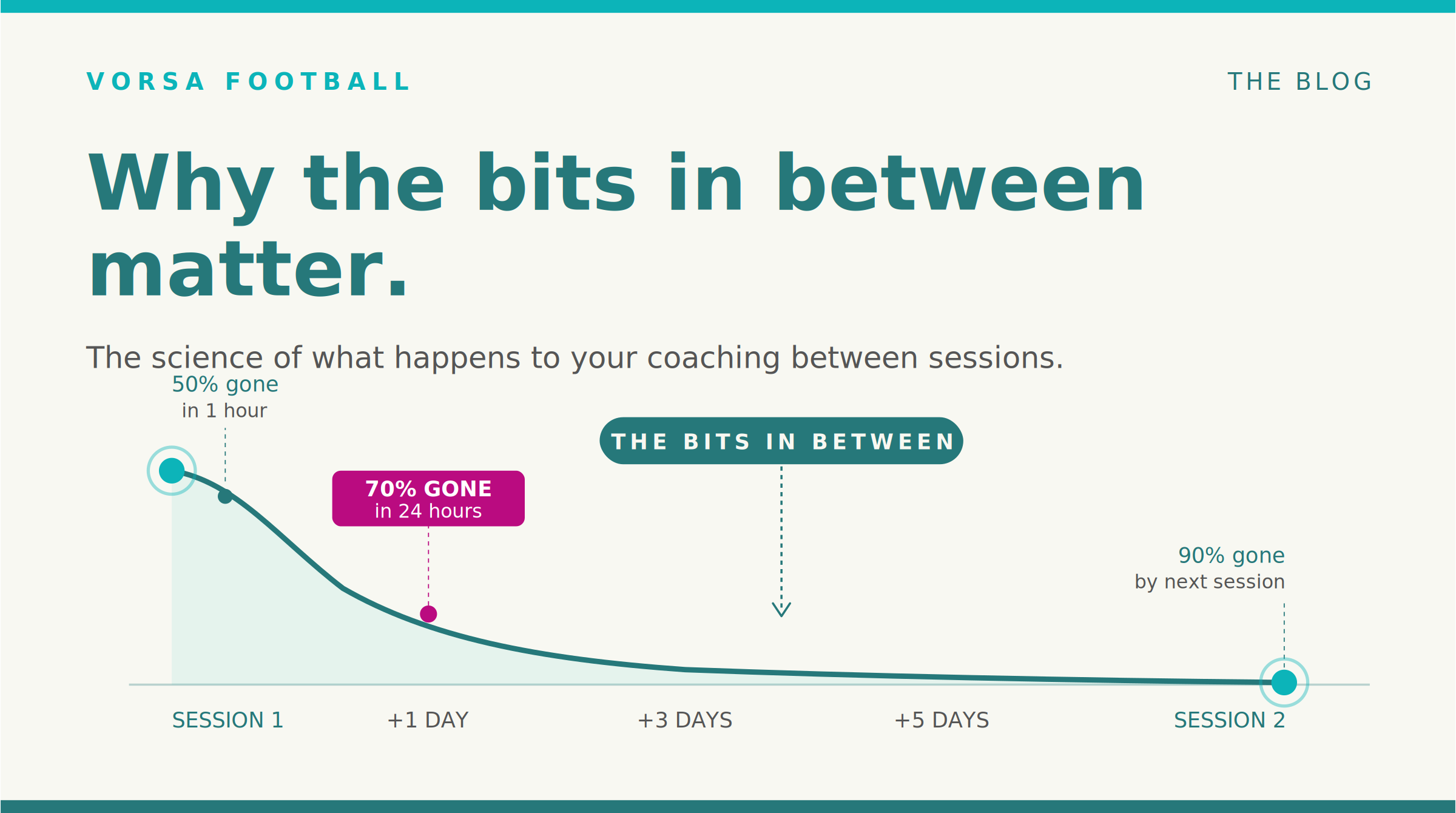
Why the Bits in Between Matter
Players forget up to 70% of a session within 24 hours. Here's what the science of memory and motor learning says about the days between training — and why it matters more than the session itself.
What the science of memory and motor learning tells us about the seven days between sessions — and why coaching only on the pitch leaves most of your work behind.
By James | Vorsa Football | 8 min read
Picture a Tuesday night session. You spend ninety minutes working on body shape when receiving — half-turns, scanning before the ball arrives, opening up to play forward. By the end, the players are getting it. They look sharp. You drive home feeling like you cracked something.
Then Saturday rolls around. Kick-off. The first ball into midfield, and one of your players takes it on the wrong foot, back to goal, no scan.
It's the moment every coach knows. And it's not because the player wasn't paying attention. It's because by the time Saturday came around, most of what you taught them was already gone.
The bits between sessions aren't dead time. They're where the learning either sticks or disappears.
The forgetting curve is brutal — and it applies to your sessions
In the 1880s, a German psychologist called Hermann Ebbinghaus did something a bit mad. He spent years memorising lists of nonsense syllables and testing himself at different intervals to see how quickly he forgot them. The pattern he found became known as the forgetting curve, and it has been replicated repeatedly in modern research, most notably by Murre and Dros at the University of Amsterdam in 2015.
The numbers are sobering. Without any reinforcement:
Within one hour, people forget around 50% of what they've just learned.
Within 24 hours, that climbs to roughly 70%.
Within a week, around 90% is gone.
Ebbinghaus's original work and Murre and Dros's replication both showed a steep initial drop, with forgetting slowing after that. The first 24 hours do most of the damage.
Now apply that to a once-a-week football session. By the time your players turn up for the next training, they've lost the majority of what you taught them. By the time match day rolls around, you might be coaching against a blank slate.
This isn't a motivation problem. It isn't a quality-of-coaching problem. It's how human memory works.
Motor skills aren't immune — they might be more vulnerable
You might think that physical skills are different. After all, we say things like "it's like riding a bike" — implying that once a body learns something, it sticks. But the research tells a more nuanced story.
Motor learning happens in two phases. The first is acquisition — what happens during the session itself, when performance improves trial by trial. The second is consolidation — what happens in the hours and days afterwards, when the brain locks the new pattern into long-term memory.
Consolidation is fragile. Research published in PLOS One has shown that when training takes place in the morning, away from sleep, motor patterns can actually deteriorate before they're stored. A single bout of moderate exercise immediately after practice has been shown to significantly improve retention 24 hours and 7 days later. Even a 24-hour gap between practice and a follow-up session affects whether a new motor pattern is retained or lost.
In other words: the work the brain does between your sessions is doing more for retention than the session itself. If nothing is reinforcing the learning during that window, the brain has no reason to keep it.
Acquisition happens in the session. Consolidation happens between them. If you only coach the first half, you're leaving the second to chance.
Why distributed practice beats massed practice — every time
Cepeda and colleagues' meta-analysis of 254 studies (2006) confirmed something that goes back to Ebbinghaus himself: distributed practice — spreading learning out across multiple sessions — produces 10–30% better retention than massed practice, where all the learning is crammed into one block.
Roediger and Butler (2011) went further. When you combine distributed practice with active retrieval — actually trying to recall and use the information — forgetting can be reduced by up to 80% over the course of a week.
The numbers behind those studies have a clear practical message for any coach:
A single 90-minute session each week is massed practice. The brain treats it as one event.
Three shorter touchpoints across the week — even 10–15 minutes each — is distributed practice. The brain treats it as repeated exposure, and locks it in.
If those touchpoints involve the player recalling what was worked on (rather than just being shown again), retention rockets.
This is well-established science. It's also, conveniently, exactly what coaches struggle to deliver when they only see their players once or twice a week on a pitch.
What this looks like for a youth footballer
Take a typical academy or grassroots player. They train with you twice a week and play a match on Saturday. That's three football touchpoints in seven days, with four days of nothing in between.
During those four days, three things determine whether last session's work survives:
1. Whether they revisit the idea
Even briefly. Research on retrieval practice shows that the act of recalling a concept — without re-teaching it — strengthens the memory significantly more than passive re-exposure.
2. Whether they get personalised feedback
A 2021 systematic review on video-based feedback in physical education found that self-modelling video feedback was superior to verbal feedback alone in seven out of eight studies. A 2021 study on weightlifting technique during COVID lockdown found that video feedback combined with a pedagogical activity produced retention effects that lasted a full week beyond the training period — while video feedback alone did not.
3. Whether the parent is part of the loop
Research published in the Journal of Applied Sport Psychology, conducted in an elite English youth football academy, found that parents are persistently "in the dark" about what their child is working on. The recommendation from that study was straightforward: bring parents into the development process from the very start. They don't need to coach. They just need to know what to reinforce.
When all three of those things happen between sessions, you stop fighting the forgetting curve. You start riding it.
The honest assessment of most coaching
Here's where I think we have to be honest as coaches. Most of us — myself absolutely included — have been pouring our energy into the wrong 25% of the week.
The two or three hours a week we have on the pitch are precious. They're where the new learning actually happens. But they are not where the learning gets retained. That happens in the 165 hours we don't see.
The traditional youth football model has no answer for this. The session ends, the kids go home, parents don't know what to ask, players don't have anything to refer back to, and by the next training a chunk of the work has been quietly lost.
You're not just competing with other coaches. You're competing with the seven days of forgetting between every session you run.
What actually works in the bits in between
Looking at what the motor learning, memory, and youth development literature actually recommends, four things come up again and again:
Personalised video feedback shortly after the session
Specific, individual, and viewable repeatedly. The research on self-modelling video and combined visual-pedagogical feedback consistently shows superior retention compared to verbal feedback alone.
Short, focused at-home tasks during the week
Distributed practice doesn't mean doing more. It means doing a little, more often. Ten minutes of focused recall and reinforcement two or three times in the week between sessions easily outperforms an extra full session at the weekend.
Visibility for parents
Parents are the most underused asset in youth football development. Not as coaches — as informed supporters. When a parent knows that this week is about "scanning before the ball arrives," they reinforce it on the school run, in the back garden, in front of a televised game. That reinforcement is gold for retention.
A way to track progress over time
Research on grit and skill development in elite youth soccer (388 players in the Hodges/Tóth-Király studies) showed that what differentiated successful young players wasn't just hours practised — it was the consistency and structured nature of that practice. Players who could see their development tracked were more likely to engage with the work between sessions.
What this means for how I coach
This is the thinking behind everything we're building at Vorsa. Not because we want to replace coaching — there is no replacement for what happens on a pitch — but because the science is unambiguous about what fills the rest of the week.
Players need to revisit, recall, and reinforce. Parents need to be in the loop. Coaches need a way to extend their work beyond the 90 minutes they get.
If you're a coach reading this, the practical takeaway is simple: your sessions are doing more than you realise, and less than you hope. They start the learning. What happens in the bits in between decides whether any of it sticks.
Coach the in-between as deliberately as you coach the session itself, and you'll see the kind of week-on-week progress that single-session coaching almost never delivers.
Research referenced in this article includes: Ebbinghaus (1885); Murre & Dros, PLOS One (2015); Cepeda et al. meta-analysis (2006); Roediger & Butler (2011); Tulving & Thomson (1973); studies on motor consolidation and acute exercise published in PLOS One and the Journal of Neuroscience; Rothstein & Arnold and subsequent work on video feedback in motor learning; the 2021 systematic review on video-based visual feedback in physical education (Springer); Haugaasen, Toering & Jordet (2014) on football-specific practice in elite youth players; and qualitative research on parental involvement in elite English football academies (Journal of Applied Sport Psychology, 2022).
Want to bring this approach into your coaching? Vorsa Football helps coaches run online programmes built around exactly this principle — personalised video feedback, between-session tasks, and visibility for parents. Visit vorsa.app to learn more.